
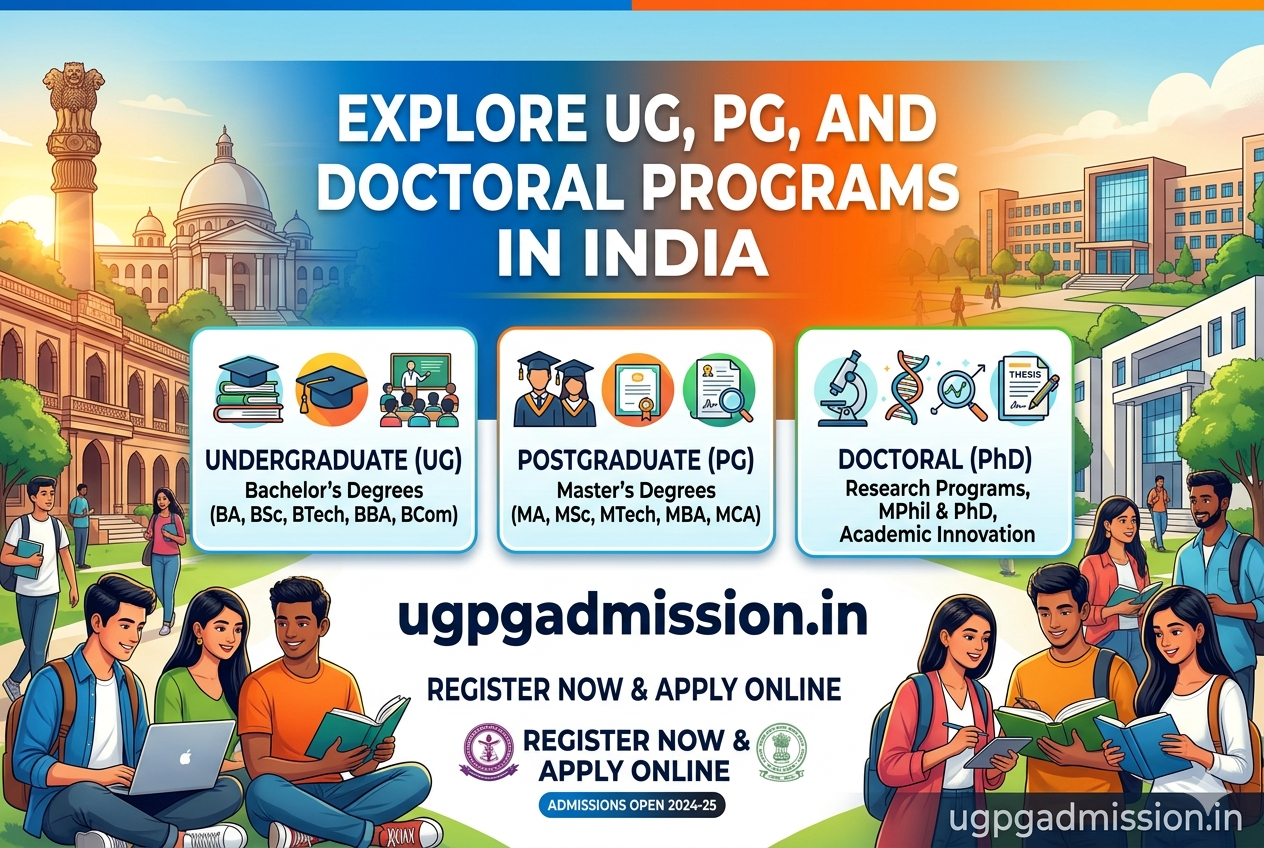
Choosing the right academic path after school or graduation can shape your entire career. Whether you’re planning to pursue an undergraduate degree, specialize through a postgraduate course, or dive deep into research with a doctoral program, India offers a wide range of opportunities across top universities.
This guide will help you explore UG, PG, and PhD programs in India, compare courses, understand eligibility, fees, admission processes, and evaluate career outcomes—so you can make an informed decision.
👉 Check Programs | Get Admission Guidance
📘 Download Course Guide
Overview of Higher Education in India
India’s higher education system is one of the largest in the world, offering diverse academic programs across disciplines.
Structure of the Indian Education System
Higher education in India is broadly divided into three levels:
Undergraduate (UG)
- First level after 10+2
- Builds foundational knowledge in a chosen field
Postgraduate (PG)
- Advanced specialization after graduation
- Focus on skill development and career readiness
Doctoral (PhD)
- Research-based programs
- Highest academic qualification
Role of Universities in Career Growth
Universities in India play a crucial role in:
- Skill development
- Industry exposure
- Research opportunities
- Placement and career advancement
Public vs Private Universities
| Feature | Government Universities | Private Universities |
|---|---|---|
| Fees | Low to moderate | Moderate to high |
| Admission | Merit-based & entrance exams | Flexible, often merit + direct |
| Infrastructure | Varies | Generally modern |
| Placement | Strong in top institutes | Strong in premium private institutions |
Undergraduate (UG) Programs in India
UG programs are the starting point for higher education and career building.
Popular UG Courses
Students can choose from a wide variety of undergraduate courses:
BBA (Bachelor of Business Administration)
- Ideal for management careers
- Focus on business fundamentals
BTech / BE (Engineering)
- One of the most popular career paths
- Specializations: Computer Science, Mechanical, Civil, etc.
BCom (Bachelor of Commerce)
- Focus on finance, accounting, and business
BA (Arts & Humanities)
- Subjects: Psychology, Sociology, English, Political Science
BSc (Science)
- Focus on scientific disciplines like Physics, Chemistry, Biology
Law Programs (BA LLB, BBA LLB)
- Integrated 5-year law degrees
- Career in legal professions
Key Details
- Duration: 3 to 4 years
- Eligibility: 10+2 from a recognized board
- Admission Types:
- Merit-based admission
- Entrance exam-based admission
Common Entrance Exams
- CUET (Common University Entrance Test)
- JEE Main & Advanced
- State-level entrance exams
Career Outcomes After UG
- Entry-level jobs
- Skill-based careers
- Preparation for postgraduate studies
Postgraduate (PG) Programs in India
Postgraduate programs help students gain specialization and improve employability.
Popular PG Courses
MBA / PGDM
- Most sought-after management programs
- High ROI in terms of career growth
MTech / ME
- Advanced engineering specialization
- Ideal for technical careers
MCom
- For commerce graduates
- Focus on finance, taxation, accounting
MA Programs
- Humanities and social sciences specialization
MSc Programs
- Advanced science education and research preparation
LLM
- Specialization in law
Key Details
- Duration: 1 to 2 years
- Eligibility: Graduation in relevant field
Admission Tests
- CAT, XAT, MAT, CMAT
- GATE (for engineering)
- CUET PG
Career Outcomes After PG
- Managerial roles
- Specialized industry jobs
- Teaching and research opportunities
Doctoral (PhD) Programs in India
PhD programs are ideal for students interested in research, academia, or policy-making.
Areas of Research
- Management and Business Studies
- Engineering and Technology
- Social Sciences
- Science and Life Sciences
- Law and Humanities
Key Details
- Duration: 3 to 6 years
- Eligibility: Master’s degree (in most cases)
Admission Process
- Entrance exam
- Personal interview
- Research proposal submission
Career Outcomes After PhD
- Professor or Lecturer
- Research Scientist
- Policy Advisor
- Industry Research Roles
Admission Process in Indian Universities
Understanding the admission process can simplify your journey.
Step-by-Step Guide
Step 1: Choose Program and University
Research courses, rankings, and placement records.
Step 2: Check Eligibility Criteria
Ensure you meet academic requirements.
Step 3: Appear for Entrance Exams
Depending on your course, prepare for relevant exams.
Step 4: Apply Online
Use:
- University portals
- Centralized systems like CUET
Step 5: Counselling and Seat Allotment
Participate in counselling sessions.
Step 6: Document Verification and Fee Payment
Finalize admission by submitting documents and fees.
Entrance Exams Overview
Entrance exams play a major role in university admissions in India.
Major Exams
CUET UG and PG
- Centralized exam for many universities
JEE Main and Advanced
- For engineering admissions (IITs, NITs)
CAT / XAT / MAT / CMAT
- For MBA and management programs
GATE
- For MTech and PSU jobs
University-Specific Exams
- Conducted by private and deemed universities
Fee Structure Overview
Understanding fees helps in planning your education.
Government Universities
- Affordable fee structure
- Subsidized education
Private Universities
- Higher fees
- Better infrastructure and facilities
IITs / IIMs / Central Universities
- Subsidized but competitive
- Strong placement records
Scholarships and Financial Aid
- Merit-based scholarships
- Need-based financial support
- Government schemes
Top Universities in India
Students can choose from a wide range of institutions:
Categories
Central Universities
- Funded by the central government
State Universities
- Managed by state governments
IITs and NITs
- Top engineering institutions
Private Universities
- Offer modern infrastructure and global exposure
Deemed Universities
- Autonomous institutions with academic flexibility
Suggested Filters
When comparing universities, consider:
- Location
- Fees
- Ranking
- Placement records
Explore Programs in India – Career Path Mapping
Understanding your academic journey helps in long-term planning.
Education Flow
UG → PG → PhD → Career Growth
Pathways
- UG → Job or PG
- PG → Specialized Career or PhD
- PhD → Academia / Research / Leadership Roles
UG vs PG vs PhD: Comparison
| Criteria | UG | PG | PhD |
|---|---|---|---|
| Level | Beginner | Advanced | Expert |
| Duration | 3–4 years | 1–2 years | 3–6 years |
| Focus | Fundamentals | Specialization | Research |
| Career | Entry-level jobs | Mid-level roles | Expert roles |
| Salary | Moderate | Higher | Highest (long-term) |
Key Differences
- UG builds foundation
- PG adds specialization
- PhD focuses on innovation and research
FAQs – Explore Programs in India
It depends on your interests:
Engineering → BTech
Business → BBA
Commerce → BCom
Arts → BA
Yes, for university-level teaching, a PhD is usually required.
Difficulty varies, but exams like MAT are generally considered easier than CAT.
Government: Affordable, competitive
Private: Flexible, modern
Yes, many universities allow switching fields, especially in management and humanities
Confused about your career?
Get personalized college recommendations today